
Oct 22, 1979. My 18th birthday.
I was standing in the hallway of our home in Germany, pulling on my parka to cycle to school. My mother approached me to wish me happy birthday. Her wish for me: that I would never have children as horrible as the one I was.
You can tell from those words that things had not been going well in my family. On the surface, we were quite privileged: nice home, education, music, travel. Emotionally, however, our family was a war zone that had been raging for generations.
I escaped to university, initially to study biology. By the early 90s, after several changes of direction, I found myself in Scotland, working with people on the margins of society: homeless individuals with severe mental illness, sex trade workers, people affected by HIV/AIDS, at-risk youth. People whose lives had been visibly devastated by trauma. I loved the work but became frustrated when I realized that all we were doing was putting band-aids on problems with much deeper roots.
That realization caused me to pivot and return to university a second time to train as a person-centered counsellor. I felt that I had finally found what I was meant to do in life and was really making a difference.
Then, life took another turn. I decided to return to Canada - where I was born - only to discover that my European qualifications were worthless there. I was not in a position to finance yet another university degree and had to earn a living. For years I took whatever work I could find while trying to find my way back to the intensive healing work I really wanted to do.
In about 2014, a friend of the family mentioned EFT to me. Being the left-brained science nerd that I am, I immediately went and looked at the research. It was promising but limited. I filed it away under "interesting, keep watching" - and promptly forgot all about it.
A few years later "tapping" came up in another conversation. I looked at the research again - and discovered that it had exploded. Over 100 solid studies proving efficacy. I was sold. Within a couple of days I had signed up for training - and I am not someone who normally makes big decisions in a hurry! The evidence was simply so convincing.
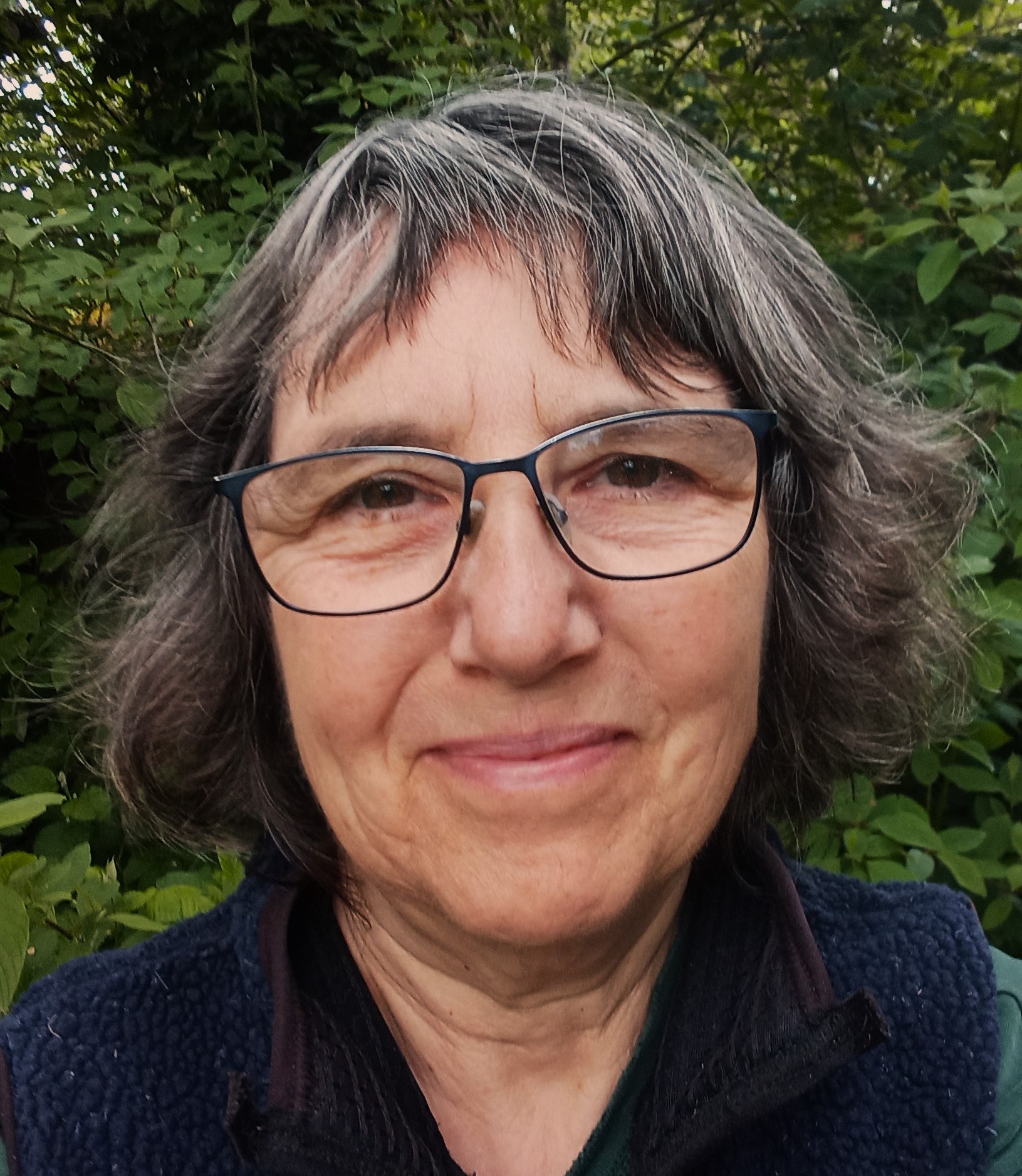
Today I combine EFT with my person-centered counseling background and lived experience with complex trauma to guide people like you through your healing journey.
Why I Focus on People Who Want to Change the World: My Theory of Change
For decades, I worked with people whose lives had been completely derailed by trauma. Their suffering is visible, acknowledged by society, and it gets services (however inadequate). But in recent years, I've realized that there is a group of trauma survivors that is just as underserved: high-functioning people who have learned to hide their pain so well that nobody realizes just how bad things really are under the surface. Often, they themselves don't realize that they need help, even though the trauma they carry rivals anything I saw in my crisis work. And when they finally do find the courage to do something about it, they discover that there are not enough professionals trained or willing to work with really deep trauma. I have lost track of the number of people who have told me that they had been turned away by therapists who tell them their trauma is "too severe" or "too complex."
This is what makes me furious: talented, skilled, visionary people with solutions the world desperately needs are stuck - not because their trauma is untreatable, but because they've been told it is. Meanwhile, we face climate crisis, social injustice, health inequities, and a thousand other urgent problems. The waste of human potential is staggering and completely unnecessary. We have tools that work. As of 2025 EFT has over 300 research studies proving its efficacy, including for severe, complex PTSD. That's why I made a deliberate choice about my practice.
As a solo practitioner, I can only work with a limited number of people. So, I focus my time and attention where it can have the greatest ripple effect: on people whose healing will create change far beyond our sessions together. That is my "scaling." Not hosting events for 20,000 people or running surface-level courses. It's working at depth with individuals who then go out and bring their gifts to hundreds or thousands of people in their lifetime, who in turn bring their gifts to the world.
When you heal the trauma that's getting in your way, you don't just feel better—you gain capacity to bring your vision to life. And when you can finally show up fully for your mission, your impact reaches far beyond what we do together in these sessions.
It's the leverage I'm looking for. Your healing multiplies outward.
Want to read more about why I believe healing is the key to creating lasting change? Read my thoughts on turning pain into purpose.
Beyond the Therapy Work
I live on a small farm on Vancouver Island, off the west coast of Canada, with my husband. We are Level 3 foster carers for children and youth with complex trauma - we experience daily how trauma shows up in everyday life and understand what actual healing requires beyond theory. On our farm, we breed endangered livestock breeds, a different kind of mission to preserve what's valuable and at risk of being lost.
I'm also a genealogist and family historian with a deep interest in intergenerational trauma - how patterns pass through family lines and how healing yourself can break cycles that have persisted for generations. Sometimes, understanding your family's story really helps with understanding the patterns you are living.
The farm, my animals, the natural world around me keep me grounded - this work is intense, and I couldn't do it without balance and connection to the earth.
If my story resonates with you, I'd be honored to explore how we might work together. You can learn more about how EFT sessions work here or book a free first session here to experience it for yourself.
No Birth Record, No Baptism: Proving a Utah Pioneer's Canadian Birth
This research for a client illustrates how to build a defensible case for a pre-civil-registration Canadian birth when direct records don't exist.
The client was able to trace her family history back to Canada through family stories and census information but needed to establish a stronger case for the purpose of claiming Canadian citizenship by descent.
Fortunately, she was able to provide quite a lot of information, including the name of her Canadian ancestor – Nancy Cunningham – as well as a location in Canada, an approximate birth date around 1826 and the name of her husband and the son from whom the client was descended.
With that, I was able to start the hunt with the 1851 Canada census. It showed 25-year-old Nancy living with her husband, Ebenezer Thane in Townsend, Norfolk, Canada West, with two children – Martha J. (4) and Janet (1). The census recorded that she was born in Canada. So far, so good. However, there was one data point that had me worried: Nancy’s religious affiliation was “Baptist”.
You may wonder why I thought that would be a problem. Well, in a perfect world, a person’s birth in Canada would be proven by either a birth certificate or a baptism registration. But birth certificates and civil registration didn’t exist at the time of Nancy’s birth. That leaves baptism as the only direct option. Unfortunately for our purposes, Baptists don’t practice infant baptism. Children born into the community are typically baptized as teenagers or young adults, when they are deemed to be mature enough to make an informed decision about joining the faith community.
This meant that we had to rely on secondary documents to show that Nancy was born in Canada.
Census records: Nancy was captured in census records twice more in her life. In 1860, in Iowa, and in 1870 in Utah. Each time she declared her place of birth to be Canada.
Obituary: Nancy died in Utah in 1877. A contemporary newspaper obituary mentioned that she was the wife of Ebenezer Thane and the daughter of Henry Cunningham of Boston, Canada West. Boston was a Hamlet within Townsend Township in Norfolk County, Canada West, which is where she was recorded living at the time of the 1851 census.
Next, I worked on establishing that Nancy’s birth family, the Cunninghams, had been living in Canada before and around the time of Nancy’s birth.
Land records
In 1823 Henry Cunningham bought land in Townsend from Job Slaght the 3rd, son of Henry Slaght for a nominal sum. In return, Henry Cunningham agreed to care for Henry Slaght for the rest of his life. This sort of arrangement is referred to as a maintenance agreement — a legal instrument in which someone, often a child or in-law of the person being cared for, receives property in exchange for taking on the obligation to support them in old age. Here, Job Slaght III conveyed land to his brother-in-law Henry Cunningham, who in turn took on the obligation to care for Henry Slaght — Job's father and Henry Cunningham's father-in-law. The family connection that made the arrangement work was Mary, who was Henry Slaght's daughter, Job's sister, and Henry Cunningham's wife.
That same year Henry Cunningham also bought land directly from Henry Slaght.
Further land records show that Henry Cunningham sold some land in Townsend in 1826, and in 1830 sold part of the land he bought from Job and Henry Slaght. The latter record mentions that the land originally belonged to Henry Slaght’s wife Abigail Heminover who died intestate, leaving her husband with a life estate and eldest son Job with the inheritance.
Will
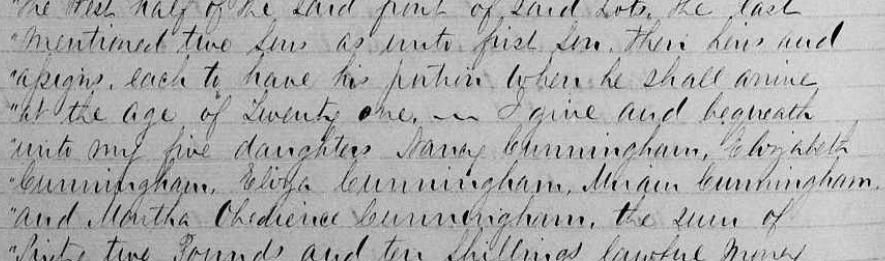
On 15 Feb 1842 Henry Cunningham made a will naming his wife Mary, 3 sons, Peter, the eldest, Abraham and Moses, and 5 daughters, Nancy, Elizabeth, Eliza, Miriam and Martha Obedience. All the girls were still bearing the last name Cunningham, so were presumably still unmarried. In the will Henry divided his land, consisting of lots 23 and 24, concession 3, between his three sons, to be handed over to them once they reached the age of 21. The girls all received monetary bequests of 60 pounds and 10 shillings.
Henry Cunningham must have died within the next couple of years, as an 1844 tax assessment lists the “widow Cunningham” on the E half of lot 23, concession 3, with 2 horses, 2 oxen and 4 milch cows! None of the Cunningham children appear in the tax assessment, which either means that Henry’s estate had not yet gone through probate or none of the boys had turned 21 yet.
Boston Baptist Community Meeting Minutes
Yes, I did say that the Baptist records wouldn’t be useful to prove Nancy was baptized in Canada. However, they are useful for showing that the Cunningham family had been in Canada for some time before Nancy’s birth. The congregation was formed in 1804, and the very first entry in the book of meeting minutes reported that the meeting was held in the home of one George Cunningham. This was Henry Cunningham’s father, Nancy’s grandfather. Also in 1804, George Cunningham made a will, naming his wife Mary, sons Abraham, Henry, William, George and Andrew and a daughter, Nancy, the aunt of the Nancy Cunningham of this case study.
The following year, 1805, George’s wife Mary joined the fellowship by being baptized. In 1826 Henry Cunningham himself and his wife were baptized. And in 1829 Henry was mentioned several times in the meeting minutes in connection with various tasks for the community, including “taking the lead of singing in worship”!
We have now shown that, on the balance of probabilities, Nancy was born in Canada, since her parents were settled there in the years bracketing her birth. The final step was to find corroborating evidence beyond just her obituary to prove that Nancy Cunningham, daughter of Henry Cunningham was the same person as Nancy, wife of Ebenezer Thane.
Let’s return to the census records for a moment. We saw that in the 1851 Canada census one Miriam Cunningham was living with Nancy and Ebenezer Thane. Miriam Cunningham was also living with the Thanes in Idaho in 1860. Henry Cunningham’s will listed a daughter Miriam, so, Miriam was Nancy Cunningham’s sister.
What I had not mentioned earlier is that while Nancy was recorded as being Baptist in the 1851 census, her husband Ebenezer declared himself to be “Mormon”. The importance of this data point will become clear shortly.
An 1848 tax assessment lists Ebenezer Thane on the SW quarter of Lot 21 in concession 2 - 50 acres of mostly uncultivated land. Also in the household is one female over the age of 16 – his wife Nancy. The tax assessment doesn’t list any children – their eldest would be born later that same year.
Nancy and Ebenezer Thane must have left Canada fairly soon after the 1851 census. “A Sketch of the County of Norfolk” by John Earl, which was printed in 1857 and lists all the properties in the county with their owners or occupants, does not show the Thanes on the property they were occupying in 1848, or anywhere else in the county.
The next US census after the 1860 one that showed them in Iowa has them living in Utah in 1870. Utah at that time was settled almost entirely by members of the Church of Jesus Christ of Latter Day Saints – “Mormons”. From 1847 through 1868 an estimated 60,000-70,000 LDS pioneers traveled to Utah by wagon or handcart in organized companies named after their appointed captains. The 1851 Canada census already told us that Ebenezer Thane had become a member of the LDS church some time before then. The LDS Church History Biographical Database shows that the Thanes travelled to Utah with the Job Pingree Company from June 7 – August 24 1861. Also travelling with them were Ebenezer’s brother John Thane with his family and Ebenezer and John’s mother, Janet (Lochhead) Thane. Nancy’s sister Miriam had married Oscar Mann in Iowa later in 1860. They did also migrate to Utah, but not in the same company. Miriam died fairly young, leaving her husband with three young children. Oscar then married his first wife’s niece, Nancy and Ebenezer’s daughter Mary Ann (or Marian or Miriam), who raised her aunt’s children.
The final piece
A granddaughter of Nancy and Ebenezer, Ruby Thayne Nielsen, compiled a family history for the Daughters of the Utah Pioneers Society. She was the daughter of Nancy and Ebenezer’s son Moroni and would have never met her grandmother as Nancy died when Moroni was only 15. However, her story is consistent with the factual data that is available and adds testimonial detail.
Summary
The family's Canadian residence at the time of Nancy's birth is established by Henry Cunningham's 1823, 1826 and 1830 land transactions in Townsend Township as well as his 1826 baptism (with his wife) in the Boston Baptist congregation and his 1842 will, bracketing the c. 1826 birth date. Nancy's parentage is established by Henry's will naming her as his daughter and by her obituary identifying Henry as her father. Nancy's identity as the Nancy Cunningham who became Nancy Thane is established by the corroborated presence of her sister Miriam — named in Henry's will, resident in Nancy and Ebenezer Thane's household in both the 1851 Canada West census and the 1860 US census and also emigrating to Utah with her husband. Ruby Thayne's family history is consistent with this evidence.
This was a fairly complex but highly interesting case, and indications are that there could be a lot more fascinating family history to discover and both the Thane and the Cunningham lines traced further generations back into the past. Nancy Cunningham and Ebenezer Thane have many descendants today who can now all benefit from this research.

@ Copyright 2026 Healing All Our Pasts | All rights reserved

@ Copyright 2026 All Our Pasts Are History
All rights reserved